Quick Answer:
The 2026 FIFA World Cup format is a new 48-team structure featuring 12 groups, a newly introduced Round of 32, and a total of 104 matches played across the USA, Mexico, and Canada over 39 days.
2026 FIFA World Cup Format Explained (48 Teams, 104 Matches Overview)
The 2026 FIFA World Cup format marks the most significant transformation in the history of the tournament. For the first time, FIFA has expanded the competition from 32 teams to 48, fundamentally changing how qualification, group stages, and knockout rounds operate. Instead of the traditional structure that football fans are used to, the tournament now follows a more layered system designed to increase global participation while also extending commercial reach.
Under this new format, the World Cup will feature 12 groups with four teams in each group. Every team will still play three matches in the group stage, but the pathway to qualification has become more complex due to the introduction of additional knockout slots. A total of 104 matches will be played, making this the largest World Cup ever staged in terms of fixtures.
What is the 2026 FIFA World Cup format?
The 2026 World Cup format explained begins with a three-stage competition structure that includes the group stage, knockout stage, and final phase. While the general idea of group-stage football remains familiar, the expansion to 48 teams has added new layers of progression that did not exist in previous tournaments.
Read more: 2026 FIFA World Cup Stadiums: Every venue, city host nation explained
Each team will enter a group of four and play every other team once. Unlike older formats where only the top two advanced, the 2026 edition introduces a system where not only the top two teams but also the eight best third-placed teams progress to the knockout rounds. This adjustment significantly increases the number of teams advancing to the next phase and keeps more nations in contention for longer.
How the 48-team structure works
The expansion to 48 teams changes the entire competitive landscape of the tournament. Instead of eight groups as seen in previous editions, the World Cup now features 12 groups, each containing four teams. This restructuring allows FIFA to include more countries from underrepresented football regions such as Asia and Africa while maintaining a balanced global representation.
Within each group, teams compete in a round-robin format where every match becomes crucial for qualification. However, unlike earlier formats where elimination often came early, the introduction of third-placed qualification means that even teams finishing outside the top two still have a chance to progress based on their overall performance.
Group stage breakdown (12 groups system)
The group stage of the 2026 World Cup is designed to be more expansive and competitive than ever before. With 12 groups in total, the tournament ensures that each team has three opportunities to earn points and secure a place in the knockout rounds.
Because of the increased number of groups, the group stage alone accounts for the majority of matches in the tournament. This structure not only extends the excitement of the early phase but also ensures that the competition remains active and unpredictable until the final round of group matches.
2026 World Cup Group Stage Format Explained
The 2026 World Cup group stage format explained reflects FIFA’s intention to create a more inclusive and globally representative tournament. The structure ensures that more nations participate while still maintaining competitive integrity through a points-based ranking system.
Read more: Canada World Cup 2026 fixtures, projected squad, predictions & analysis
Each group operates under standard football rules where wins, draws, and losses determine ranking. However, the key difference lies in how third-placed teams are evaluated across all groups. Instead of immediate elimination, these teams are compared against each other to determine which ones qualify for the knockout stage, adding an extra layer of competition across the entire group phase.
Group allocation and team distribution
The distribution of teams across the 12 groups is based on FIFA’s seeding system, which uses world rankings to ensure balanced competition. This prevents top-ranked teams from being placed in the same group early in the tournament, maintaining fairness and global competitiveness.
Each group is designed to offer a mix of strong and developing football nations, which helps maintain viewer interest while also giving smaller teams exposure on the world stage.
How third-placed teams qualify for knockout stage
One of the most important changes in the 2026 World Cup format explained is the introduction of third-placed qualification. Instead of being eliminated immediately, third-placed teams from each group are ranked against each other based on points, goal difference, goals scored, team conduct score, and FIFA world ranking.
The best eight third-placed teams then advance to the Round of 32. This system ensures that strong teams from difficult groups are not unfairly eliminated and keeps more nations engaged deeper into the tournament.
Total matches in the group stage
The group stage in 2026 will consist of 72 matches in total. This increase comes directly from the expanded number of teams and groups. With every team playing three matches, the group stage alone becomes a major part of the tournament’s overall structure and commercial value.
2026 FIFA World Cup Knockout Stage Structure
The introduction of the Round of 32 is one of the most defining changes in the 2026 World Cup format explained. For the first time in history, the tournament includes an additional knockout round before the traditional Round of 16.
This means that more teams must survive an extra elimination stage, making the path to the final longer and more demanding than ever before.
Introduction of Round of 32 explained
The introduction of the Round of 32 is one of the most defining changes in the 2026 World Cup format explained. For the first time in history, the tournament includes an additional knockout round before the traditional Round of 16.
This means that more teams must survive an extra elimination stage, making the path to the final longer and more demanding than ever before.
Road to the final (Round of 32 to Final)
From the Round of 32 onwards, the tournament follows a traditional knockout structure. Teams progress through the Round of 16, then the quarter-finals, followed by the semi-finals, and finally the World Cup final.
Each stage becomes increasingly competitive, as the margin for error disappears completely. One mistake can end a team’s World Cup journey, regardless of their group-stage performance.
Match increase impact (104 total games explained)
The expansion to 104 total matches is a direct result of the larger group stage and additional knockout round. This increase makes the 2026 World Cup the longest and most commercially significant edition ever held, with more broadcasting opportunities and global engagement than any previous tournament.
2026 World Cup Host Countries and Venues
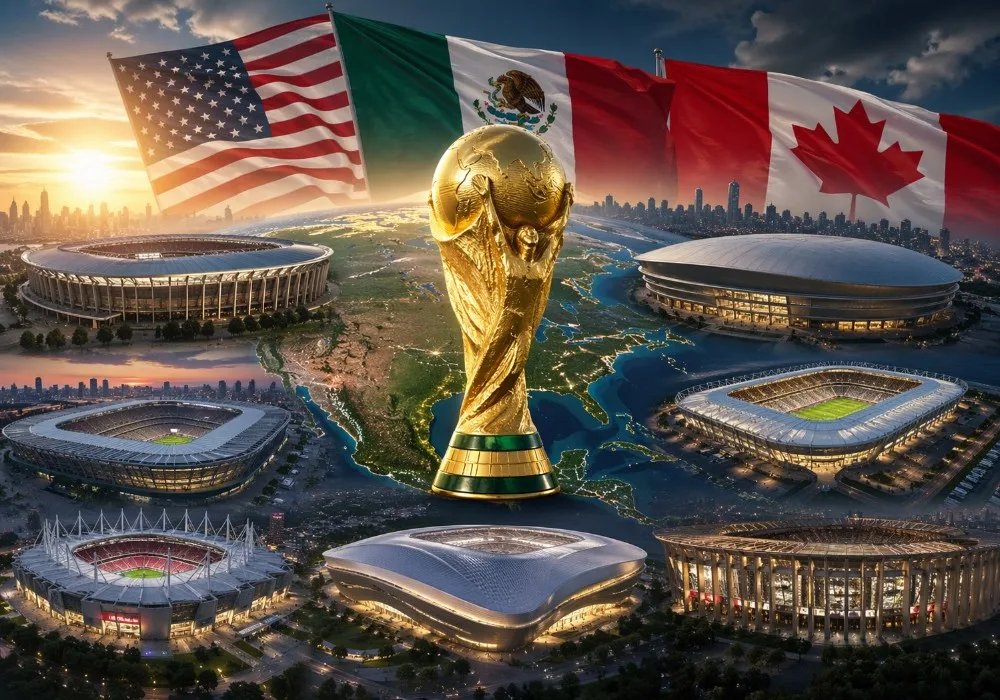
The 2026 World Cup will be hosted across three countries: the United States, Mexico, and Canada. This marks the first time in history that three nations will jointly host the tournament.
The United States will host the majority of matches, including key knockout fixtures and the final, which will be played at MetLife Stadium in New Jersey on July 19, 2026. Mexico will host the opening match at Estadio Azteca on June 11, 2026, while Canada will also host group-stage matches, ensuring that the tournament spreads across North America and reaches a diverse audience.
However, this multi-country format also introduces logistical challenges, including long-distance travel between venues and varying climate conditions across regions.
2026 World Cup Qualification Slots by Confederation
The expansion to 48 teams has significantly changed global qualification distribution. The confirmed slot allocation by FIFA is as follows:
- UEFA (Europe): 16 slots
- CAF (Africa): 9 slots
- AFC (Asia): 8 slots
- CONMEBOL (South America): 6 slots
- CONCACAF (North & Central America): 6 slots (including the three host nations)
- OFC (Oceania): 1 slot
- Intercontinental playoffs: 2 additional slots (Congo and Iraq qualified)
Notably, the 2026 edition is the first World Cup in which all six confederations have at least one guaranteed berth, with OFC receiving its first guaranteed direct slot. The introduction of intercontinental playoffs adds another competitive layer, allowing teams from different continents to fight for remaining spots.
2026 World Cup vs Previous Editions (Key Differences)
| Feature | 2022 World Cup | 2026 World Cup |
|---|---|---|
| Teams | 32 | 48 |
| Groups | 8 | 12 |
| Knockout Start | Round of 16 | Round of 32 |
| Total Matches | 64 | 104 |
| Duration | 29 days | 39 days |
| Max Matches for Winner | 7 | 8 |
| Host Countries | 1 (Qatar) | 3 (USA, Mexico, Canada) |
FIFA’s decision to expand the World Cup is driven by multiple factors, including global development and commercial growth. By increasing the number of participating teams, FIFA aims to bring more nations into the global football ecosystem and provide exposure to emerging football markets.
At the same time, the expansion significantly increases broadcasting rights, sponsorship opportunities, and global viewership, making it one of the most commercially powerful decisions in modern football history.
Criticism and Challenges of the 2026 World Cup Format
Despite its benefits, the expanded format has also faced criticism. One of the main concerns is player workload, as elite footballers may face longer seasons and reduced recovery time between matches.
There is also debate about whether increasing the number of teams could dilute the overall quality of competition, particularly in early-stage matches. Additionally, the vast geographical spread across North America introduces travel fatigue and scheduling complexity that did not exist in previous tournaments.
FAQs About 2026 FIFA World Cup Format
1- How many matches will each team play?
Minimum 3 group matches; up to 8 total if a team reaches the final.
2- Why are there 48 teams instead of 32?
To increase global participation and expand football development worldwide.
3- How does the Round of 32 work?
Top 2 teams + 8 best third-placed teams enter a single-elimination bracket.
4- Which countries are hosting the 2026 World Cup?
USA, Mexico, and Canada.
5- How many games will the winner play?
A maximum of 8 matches (3 group + 5 knockout rounds).
Conclusion
The 2026 FIFA World Cup format explained represents a historic evolution in international football. With its expanded 48-team structure, new knockout round, and record-breaking 104 matches, it becomes the most ambitious and commercially significant tournament ever organized by FIFA.
While it increases global participation and commercial value, it also introduces new debates around fairness, scheduling, and competitive balance—making it one of the most important and discussed World Cup formats in modern football history.