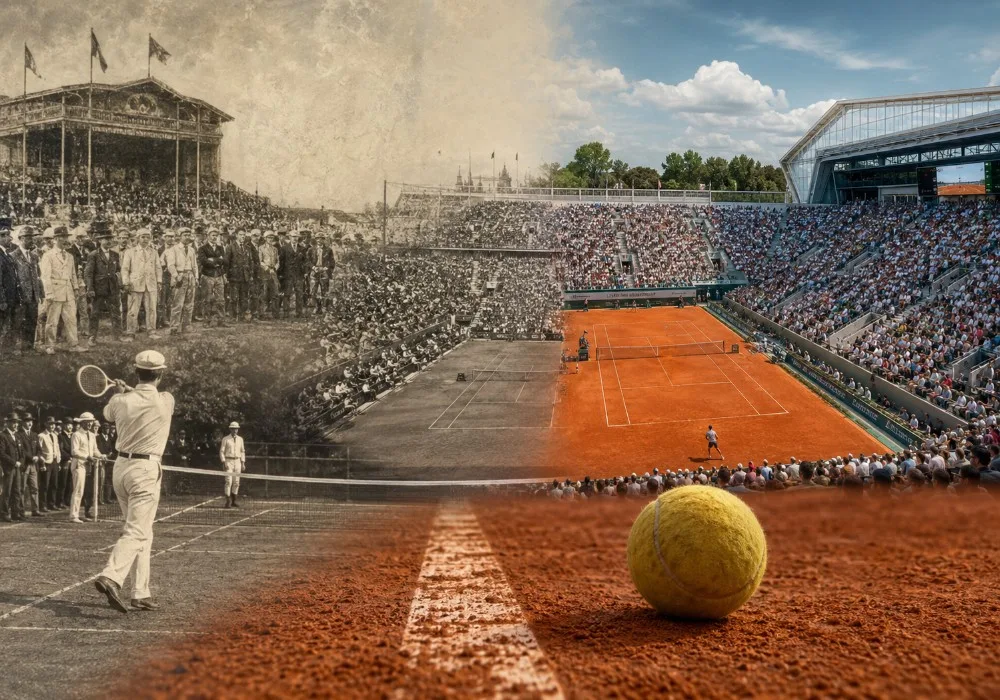
The French Open is the second Grand Slam of the tennis calendar each year and the only one contested on red clay. But long before Carlos Alcaraz, Iga Świątek, or even Rafael Nadal arrived in Paris, the tournament was a small invitational for members of a handful of French clubs. The history of the French Open spans more than 130 years, two world wars, the birth of professional tennis, and the rise of clay-court legends who shaped the modern game.
Quick Answer: The history of the French Open began in 1891 as a national tournament for members of French tennis clubs. It opened to international players in 1925, moved to the newly built Stade Roland Garros in Paris in 1928, and became the first Grand Slam of the Open Era in 1968. Today it is the only major played on red clay, with the 2026 edition running May 24 to
This guide walks through every major chapter — from the very first match in 1891 to the controversies and storylines defining Roland Garros 2026.
The Origins of the French Open – 1891
The first edition of what we now call the French Open was held in 1891 at the Société de Sport de l’Île de Puteaux, a club on a small island in the Seine just outside Paris. It was originally called the Championnat de France — the French Championships — and it bore little resemblance to the global event we know today.
A Tournament for French Club Members Only
In its earliest form, the tournament was a closed competition. Only players who belonged to French tennis clubs could enter. There was no international field, no professional circuit, and no women’s draw. The very first winner was, ironically, not French: H. Briggs, a British expatriate living in Paris and a member of the Stade Français club, won the inaugural men’s singles title, defeating P. Baigneres in straight sets.
The early decades of the tournament were dominated by French players. The most successful was Max Decugis, who won eight men’s singles titles between 1903 and 1914 — still one of the largest title totals in French Open history, even though those wins came during the pre-international era.
Other key milestones during this opening chapter:
- 1892–1907: Matches were played on sand courts laid over a rubble base.
- 1897: The first women’s singles tournament was added, with just four entries.
- 1902: Mixed doubles was introduced.
- 1907: Women’s doubles was added.
- 1908: The tournament moved to red clay — the surface that defines it to this day.
- 1915–1919: The tournament was suspended due to the First World War.
For the first 34 years of its existence, the championship remained a French-only affair. That was about to change.
Opening to International Players – 1925
In 1925, the French Tennis Federation (FFT) made one of the most consequential decisions in the tournament’s history: it opened the championships to international amateur players. That same year, the International Lawn Tennis Federation officially recognised the French Championships as a major championship, putting it on equal footing with Wimbledon, the US National Championships, and the Australasian Championships.
The first international winner of the men’s singles title was René Lacoste — yes, the same Lacoste who later founded the clothing brand bearing his name and crocodile logo. Lacoste was part of a generation of French players who were about to change the sport forever.
This 1925 expansion is the moment most historians point to as the true birth of the modern French Open, because from this year forward, every champion’s name belongs to the official Grand Slam roll of honour.
The Move to Stade Roland Garros – 1928
If 1925 made the French Championships a global event, 1928 gave it the home that would define it forever: the Stade Roland Garros, built at Porte d’Auteuil on the western edge of Paris.
The Davis Cup Triumph That Built a Stadium
The story behind the stadium is one of the great moments in French sporting history. In 1927, four French players — Jean Borotra, Jacques Brugnon, Henri Cochet, and René Lacoste, collectively known as The Four Musketeers — travelled to Philadelphia and defeated the United States to win the Davis Cup. It was the first time France had ever won the trophy.
By the rules of the Davis Cup, France would have to defend the title on home soil the following year. The problem: France did not have a tennis stadium remotely large enough to host the event. The Stade Français club stepped in and offered three hectares of land near Porte d’Auteuil for a brand-new venue — on one condition.
Why It Was Named After an Aviator
The condition set by Stade Français was that the new stadium had to be named after one of its former members: Roland Garros, the French aviation pioneer who had been the first person to fly solo across the Mediterranean Sea in 1913 and who had been killed in aerial combat on October 5, 1918 — just one month before the end of World War I.
Read more: How to watch French Open 2026 in USA
Garros was not a great tennis player. He played some at school, but his real passions were rugby, football, and flight. Yet his bravery in war and his pioneering aviation feats had made him a national hero, and his old friend Emile Lesueur — then president of the Stade Français — pushed for the tribute.
The condition was accepted. The new stadium opened in 1928, France successfully defended the Davis Cup against the United States there, and on May 24, 1928, the French Championships moved to their new home at Stade Roland Garros. The tournament has been played there every year since.
The Four Musketeers Era
The years between 1924 and 1932 are remembered as the era of the Mousquetaires. In that nine-year span, the French Open men’s singles title was won every single year by one of the four — Borotra (twice), Cochet (four times), Lacoste (three times). Brugnon was the doubles specialist of the group and won the men’s doubles five times.
The men’s singles trophy, the Coupe des Mousquetaires, is named in their honour. It was redesigned in 1981 by the Parisian jewellery house Mellerio dits Meller — a wide-necked silver cup framed with vine leaves and twin swan-shaped handles. The original cup never actually leaves the FFT president’s office: every champion receives a slightly smaller replica to take home.
When the 1925 generation faded, the trophy began to travel. Jack Crawford of Australia became the first non-French winner in 1933, and the era of pure French dominance was over. From 1933 until the Open Era began, no Frenchman would win the men’s title other than Marcel Bernard in 1946.
World Wars and Tournament Pauses (1915–1919, 1940)
The French Open is one of the rare sporting events whose history runs straight through both world wars.
- 1915–1919: The tournament was not held due to the First World War. The same conflict that claimed Roland Garros himself.
- 1940: The 1940 edition was cancelled outright after Germany invaded France.
- 1941–1944: Under German occupation, an unofficial tournament called the Tournoi de France was held at Roland Garros. The Stade Roland Garros itself was repurposed during this period — at various points it served as a storage facility, an internment site, and a medical facility. The Tournoi de France was open only to French nationals and local club members, and the Fédération Française de Tennis does not officially recognise these editions as part of the tournament’s record.
- 1946: The French Championships resumed officially, and Marcel Bernard became the post-war champion. He remains the only Frenchman to have won the men’s singles title between 1933 and the Open Era.
The Open Era Begins (1968)
For most of the 20th century, Grand Slam tournaments were closed to professional players. Only amateurs could compete, even though many of the world’s best players — including former Wimbledon and US champions — had turned professional and were therefore locked out of the biggest events. The arrangement was known as “shamateurism,” because top amateurs were often paid under the table.
Read more: How to watch French Open 2026 in Canada
In 1968, that finally changed. Amid the political upheaval of the French general strike, the French Championships became the first Grand Slam tournament to admit professional players alongside amateurs, ushering in what is now known as the Open Era of tennis. The name “French Open” became the standard English usage from this point onward.
The first Open Era champions were Ken Rosewall of Australia and Nancy Richey of the United States. Rosewall, who had been barred from Grand Slam play for over a decade because he had turned pro, finally got to win another major at age 33.
The other three Slams followed France’s lead within months. Tennis would never look the same again.
Legendary Champions in French Open Champions List
No clay-court Slam carries the same weight as Roland Garros, and the players who have conquered it are some of the most decorated in tennis history. The French Open champions list reads like a who’s-who of the sport.
Men’s Singles — Borg, Lendl, Nadal, Federer, Djokovic, Alcaraz
The men’s record book is dominated by one name: Rafael Nadal. The Spaniard won the title an unprecedented 14 times between 2005 and 2022 — including five in a row from 2010 to 2014. No player in tennis history has won a single Grand Slam tournament more often.
| Player | Titles | Years |
|---|---|---|
| Rafael Nadal | 14 | 2005–08, 2010–14, 2017–20, 2022 |
| Björn Borg | 6 | 1974–75, 1978–81 |
| Novak Djokovic | 3 | 2016, 2021, 2023 |
| Henri Cochet | 4 | 1922, 1926, 1928, 1930 |
| Ivan Lendl | 3 | 1984, 1986, 1987 |
| Gustavo Kuerten | 3 | 1997, 2000, 2001 |
| Mats Wilander | 3 | 1982, 1985, 1988 |
A few records worth knowing:
- Michael Chang (1989) is still the youngest men’s singles champion at 17 years and 3 months.
- Novak Djokovic (2023) became the oldest Open Era men’s champion at 36 years and 20 days.
- Carlos Alcaraz won back-to-back titles in 2024 and 2025, becoming the first Spaniard since Nadal to win consecutive Roland Garros crowns.
- Andre Agassi completed his Career Grand Slam at Roland Garros in 1999 — the first Open Era man to do so.
Women’s Singles — Court, Evert, Graf, Seles, Williams, Świątek, Gauff
The women’s record is held by Chris Evert, who won the title seven times between 1974 and 1986 — and never lost a French Open final in the Open Era when she made one.
| Player | Titles | Years |
|---|---|---|
| Chris Evert | 7 | 1974, 1975, 1979, 1980, 1983, 1985, 1986 |
| Steffi Graf | 6 | 1987, 1988, 1993, 1995, 1996, 1999 |
| Margaret Court | 5 | 1962, 1964, 1969, 1970, 1973 |
| Iga Świątek | 4 | 2020, 2022, 2023, 2024 |
| Justine Henin | 4 | 2003, 2005, 2006, 2007 |
| Monica Seles | 3 | 1990, 1991, 1992 |
| Serena Williams | 3 | 2002, 2013, 2015 |
Notable women’s records:
- Monica Seles (1990) is the youngest women’s singles champion at 16 years and 6 months.
- Iga Świątek dominated the early 2020s on Parisian clay, winning four titles in five years.
- Coco Gauff broke through to win her first Roland Garros title in 2025, defeating Aryna Sabalenka in the final, and returns as defending champion in 2026.
Modern Roland Garros Stadium History (2000s–Present)
The 21st century has reshaped both the venue and the sporting calendar at Roland Garros.
2001 — The main court was renamed Court Philippe-Chatrier, in honour of the former FFT president who pushed for global expansion of the tournament.
2006 — The tournament began starting on a Sunday, with 12 first-round singles matches played on the three show courts to extend the event by one day.
2007 — Equal prize money for men and women was fully implemented, and wheelchair tennis was added to the official roster of events.
2019–2020 — After more than €400 million in renovations, Court Philippe-Chatrier received its long-awaited retractable roof, ending decades of weather disruptions and finally bringing Roland Garros into line with the other three Grand Slams. The court is now also used for night sessions, broadcast exclusively in France by Amazon Prime Video.
2020 — The tournament was postponed from May to September because of the COVID-19 pandemic — the first major scheduling change in its modern history.
2025 — A plaque featuring the imprint of Rafael Nadal’s sneakers was installed on Court Philippe-Chatrier to honour his 14 titles.
2026 — Roland Garros becomes the only Grand Slam still using human line judges, after the Australian Open, Wimbledon, and US Open all shifted to electronic line calling. The 2026 edition also marks the first Grand Slam to permit connected wearables (such as Whoop bands) during matches, allowing players access to live performance data.
Roland Garros at a Glance: Key Dates Timeline
| Year | Event |
|---|---|
| 1891 | First Championnat de France held at Île de Puteaux |
| 1897 | Women’s singles added |
| 1908 | Red clay surface introduced |
| 1915–1919 | Tournament suspended (World War I) |
| 1925 | Opened to international players; recognised as a major |
| 1927 | The Four Musketeers win the Davis Cup |
| 1928 | Moved to the new Stade Roland Garros |
| 1940 | Tournament cancelled (World War II) |
| 1941–1944 | Unofficial Tournoi de France held under German occupation |
| 1946 | Official tournament resumes; Marcel Bernard wins |
| 1968 | Open Era begins — first Grand Slam to admit professionals |
| 1989 | Michael Chang becomes youngest men’s champion |
| 2001 | Centre court renamed Philippe-Chatrier |
| 2007 | Equal prize money fully implemented |
| 2020 | Tournament postponed to September due to COVID-19 |
| 2022 | Rafael Nadal wins his 14th and final French Open title |
| 2023 | Novak Djokovic becomes oldest Open Era men’s champion |
| 2024 | Iga Świątek wins her fourth title; Alcaraz wins first |
| 2025 | Coco Gauff wins maiden title; Alcaraz defends |
| 2026 | Alcaraz withdraws with wrist injury; Gauff defends |
Frequently Asked Questions
When did the French Open start? The French Open began in 1891 as the Championnat de France, a national tournament for members of French tennis clubs. It became an international event in 1925 and joined the Open Era in 1968.
Who won the first French Open? The first French Open men’s singles title was won in 1891 by H. Briggs, a British expatriate residing in Paris and a member of the Stade Français club. The first women’s singles event was held in 1897.
Why is the French Open played on clay? Roland Garros has been played on red clay since 1908. The slow surface produces longer rallies and rewards endurance, defence, and topspin — making it the most physically demanding of the four Grand Slams.
Who has won the most French Open titles? Rafael Nadal holds the men’s record with 14 titles, and Chris Evert holds the women’s record with 7. Nadal also holds the men’s Open Era record for most consecutive wins (5, from 2010 to 2014).
When did the French Open become a Grand Slam? The French Championships were officially recognised as a major championship in 1925, when the tournament opened to international amateur players. It became the first Grand Slam to admit professionals during the Open Era in 1968.
Why was the French Open moved to Stade Roland Garros? After the Four Musketeers won the 1927 Davis Cup, France needed a new stadium large enough to host the 1928 defence. The Stade Français club donated three hectares of land on the condition that the new venue be named after their late member, the aviator Roland Garros.
Has the French Open ever been cancelled? Yes — the tournament was suspended from 1915 to 1919 due to World War I and cancelled in 1940 due to World War II. An unofficial Tournoi de France was held under German occupation from 1941 to 1944, but those editions are not recognised by the FFT.